Can it run Doom? Part 1: a C library with no operating system
Sooner or later, every piece of hardware gets asked the same question:
can it run Doom? Calculators, printers and pregnancy tests have all
answered yes. A Raspberry Pi running Linux is too easy to count, so this
series asks the question of a Pi with no operating system at all: just
rpi-hal, a Pi 2B, and a copy of DOOM.WAD.
It runs. This series covers how, in four parts:
- A C library with no operating system (this post): getting a 1990s C engine to build, start and read its game data.
- The framebuffer: getting the picture on screen, and keeping its proportions.
- USB input: a keyboard, which on a Pi means writing a USB host.
- Audio: sound effects and music, on a core of their own.
The code is in rpi-doom.
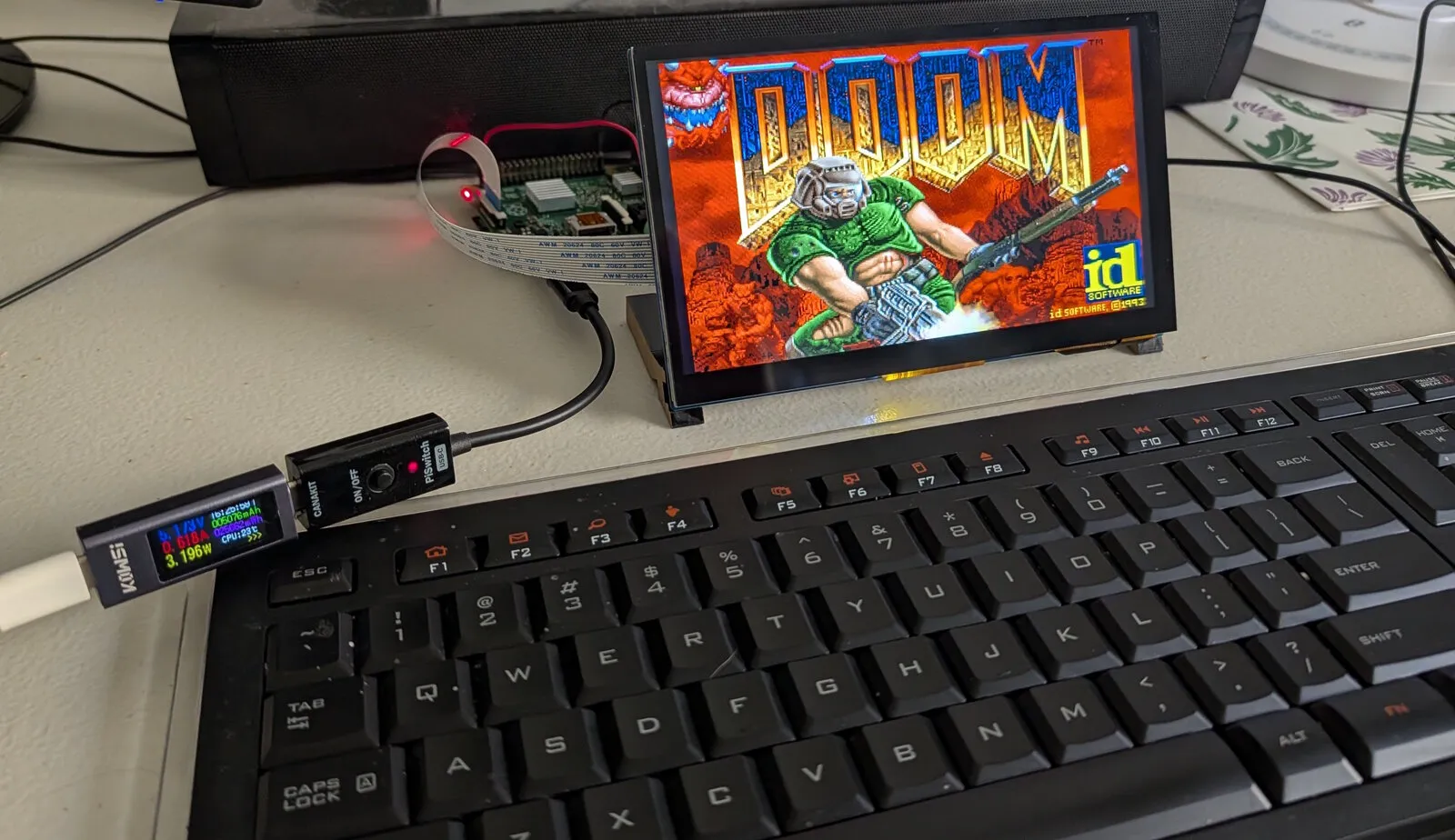
Doom on anything
Section titled “Doom on anything”id Software released Doom’s source in 1997 and put it under the GPL in 1999, and ports have been piling up ever since. The one that makes porting easy is doomgeneric. It cuts the engine’s connection to the platform down to a handful of functions you write:
| Function | What the engine wants |
|---|---|
DG_Init |
Set up whatever you need |
DG_DrawFrame |
Show the finished frame |
DG_SleepMs |
Wait this many milliseconds |
DG_GetTicksMs |
Milliseconds since startup |
DG_GetKey |
The next key press or release, if any |
DG_SetWindowTitle |
Name the window |
That looks like an afternoon’s work, and the hooks themselves are. The
catch is everything the engine uses besides those hooks. Doom is
1990s C, and it takes a C library for granted: printf for its
startup log, malloc for memory, fopen and fread for the WAD,
<math.h>, <string.h>. On a bare-metal Pi, none of it exists.
newlib
Section titled “newlib”The usual answer on embedded systems is
newlib, a C library meant for machines
without an operating system. The ARM toolchain ships it ready-built
(arm-none-eabi-newlib on most distributions) as two archives:
libc.a:printf,malloc,fopen,strcmpand the rest of the standard C library.libm.a: the maths functions in<math.h>.
newlib is portable because it never touches hardware itself. When
malloc needs more memory it calls _sbrk; printf ends in _write;
fopen and fread end in _open and _read. On Linux those are
system calls. On bare metal, newlib leaves them for you to write, about
fifteen functions in all.
So that’s the shape of the port: the engine and newlib are C on top, and the layer underneath them is Rust. The engine reaches it two ways: through newlib for memory, files and its log, and directly through the doomgeneric hooks for the screen, the clock and the keyboard.
flowchart TD
    subgraph C
        engine["Doom engine (doomgeneric)"]
        newlib["newlib: libc.a, libm.a"]
    end
    subgraph Rust
        syscalls["newlib syscalls<br/>_sbrk, _write, _open, _read, ..."]
        hooks["doomgeneric hooks<br/>DG_DrawFrame, DG_GetKey, ..."]
        fat["resident-fat<br/>files on the SD card"]
        hal["rpi-hal<br/>UART, framebuffer, USB, timer"]
    end
    engine -- "printf, malloc, fopen" --> newlib
    newlib --> syscalls
    engine -- "frames, time, keys" --> hooks
    syscalls --> fat
    syscalls --> hal
    hooks --> hal
    fat --> hal
Building the C
Section titled “Building the C”The engine is compiled by build.rs with the
cc crate and arm-none-eabi-gcc. The
flags have to match the Rust target, armv7a-none-eabi, exactly:
const ARCH_FLAGS: &[&str] = &[ "-marm", // 32-bit ARM instructions, not Thumb "-march=armv7-a", "-mfloat-abi=soft", // no FPU registers in the calling convention "-mno-unaligned-access", // the Rust target assumes strict alignment];The same flags pick which newlib to link. The toolchain ships one build
of libc.a per architecture and float ABI, and asking the compiler with
the same flags finds the right one:
Command::new("arm-none-eabi-gcc") .args(ARCH_FLAGS) .arg("-print-file-name=libc.a")The OS layer, in Rust
Section titled “The OS layer, in Rust”Each newlib syscall is an extern "C" function in
src/newlib.rs.
Most are short.
Memory. _sbrk grows newlib’s heap, and here it hands out a 32 MiB
block carved from the Rust heap at boot. Doom’s zone allocator takes 6
MiB of that up front; the rest goes to newlib’s buffers and the engine’s
smaller allocations.
#[unsafe(no_mangle)]pub extern "C" fn _sbrk(increment: isize) -> *mut c_void { let grown = critical_section::with(|cs| { let arena = &mut *ARENA.borrow_ref_mut(cs); let used = arena.used.checked_add_signed(increment)?; if used > arena.len { return None; } let old_end = arena.base.wrapping_add(arena.used); arena.used = used; Some(old_end) }); match grown { Some(old_end) => old_end.cast(), None => { fail(Errno::NoMemory); usize::MAX as *mut c_void // (void *)-1 } }}The console. _write to stdout or stderr goes to the serial
console. printf writes in pieces, so the bytes are gathered until a
newline and logged as whole lines.
_fstat is where the C side’s memory layout matters. newlib asks it
what a file descriptor is and how long the file is, through a
struct stat it allocated itself. The Rust side has to write into
exactly the right offsets, so it carries its own repr(C) copy, with
the layout checked at compile time:
#[repr(C)]pub struct Stat {    _dev_ino: [u16; 2],    mode: u32,    _nlink_uid_gid_rdev: [u16; 4],    size: c_long,    _rest: [u8; 68],}
const _: () = assert!(size_of::<Stat>() == 88);const _: () = assert!(core::mem::offset_of!(Stat, mode) == 4);const _: () = assert!(core::mem::offset_of!(Stat, size) == 16);
It also matters what _fstat reports. The console descriptors say
they’re character devices, which is what makes newlib line-buffer
stdout, so the startup log arrives a line at a time.
Exiting. Quit Game, and every fatal I_Error, end in _exit.
There’s nothing to return to, so it logs the status, blanks the screen
and halts. Without the blanking, the last frame stays up and looks
exactly like a hang.
Files on the SD card
Section titled “Files on the SD card”_open, _read, _lseek and _write go to a small open-file table in
src/files.rs,
over resident-fat, a FAT32
crate that keeps the card’s allocation table and directories in RAM.
Relative paths resolve under doom/ on the card, so the engine finds
its WAD exactly where a DOS install would have it: in its working
directory.
To try it yourself, put a WAD in a local doom/ directory and run:
make sd-card-releaseThat builds the game and assembles a complete card in
target/sd-card-release/: the Pi’s boot firmware, config.txt, the
game as kernel7.img, and the WAD in doom/. Copy everything in it
onto a FAT32 card and power on. (For working on the code there’s
make sd-card-dev, which puts rpi-loader
on the card instead, so each build goes over a serial cable.)
First boot
Section titled “First boot”With the hooks drawing frames (part 2) and no input yet, the engine
starts, loads DOOM.WAD and runs its attract loop: the title screen,
then demos of the first levels, playing themselves.
This is the serial console from a boot of the finished port (with no
keyboard plugged in, as it says). Each line is stamped with the seconds
since the kernel started. The first lines are the Rust side setting up
the board; from Doom Generic 0.1 on, it’s the engine’s own printfs,
arriving through _write:
[ 0.000] rpi-doom: hello from the Raspberry Pi 2 (B)[ 0.004] arm: 900 MHz[ 0.005] heap: 942 MiB[ 0.210] storage: FAT volume at block 2048[ 0.213] storage: 247255 clusters of 4 KiB, 965 KiB of allocation table in RAM[ 0.220] audio: core 1, 48828 Hz[ 1.163] usb: no keyboard found; plug one in before booting[ 1.167] display: 800x480[ 1.173] framebuffer: 667x400, pitch 2688 bytes, at 0x3eaf2000[ 1.179] Doom Generic 0.1[ 1.183] Z_Init: Init zone memory allocation daemon.[ 1.188] zone memory: 0x663de0, 600000 allocated for zone[ 1.193] V_Init: allocate screens.[ 1.197] M_LoadDefaults: Load system defaults.[ 1.202] saving config in default.cfg[ 1.209] -iwad not specified, trying a few iwad names[ 1.213] Trying IWAD file:doom2.wad[ 1.217] Trying IWAD file:plutonia.wad[ 1.221] Trying IWAD file:tnt.wad[ 1.224] Trying IWAD file:doom.wad[ 1.227] W_Init: Init WADfiles.[ 1.231] adding doom.wad[ 1.239] ===========================================================================[ 1.245] DOOM Registered[ 1.250] ===========================================================================[ 1.258] Doom Generic is free software, covered by the GNU General Public[ 1.265] License. There is NO warranty; not even for MERCHANTABILITY or FITNESS[ 1.272] FOR A PARTICULAR PURPOSE. You are welcome to change and distribute[ 1.279] copies under certain conditions. See the source for more information.[ 1.287] ===========================================================================[ 1.295] I_Init: Setting up machine state.[ 1.303] M_Init: Init miscellaneous info.[ 2.484] R_Init: Init DOOM refresh daemon - ..........................[ 2.489] P_Init: Init Playloop state.[ 2.497] S_Init: Setting up sound.[ 2.499] D_CheckNetGame: Checking network game status.[ 2.505] startskill 2 deathmatch: 0 startmap: 1 startepisode: 1[ 2.511] player 1 of 1 (1 nodes)[ 2.514] Emulating the behavior of the 'Doom 1.9' executable.[ 2.520] HU_Init: Setting up heads up display.[ 2.550] ST_Init: Init status bar.[ 2.620] doom: DOOM Registered[ 2.621] I_InitGraphics: framebuffer: x_res: 640, y_res: 400, x_virtual: 640, y_virtual: 400, bpp: 32[ 2.631] I_InitGraphics: framebuffer: RGBA: 8888, red_off: 16, green_off: 8, blue_off: 0, transp_off: 24[ 2.640] I_InitGraphics: DOOM screen size: w x h: 320 x 200[ 2.646] I_InitGraphics: Auto-scaling factor: 2[ 2.672] audio: 452 chunks played[ 2.685] audio: chunk fill average 0 us, worst 0 us, of 5242 usThe engine is ready to draw its first frame about 2.7 seconds after the
kernel starts. The longest step by far is R_Init, loading the WAD’s
textures and sprites, at about 1.2 seconds.
Here’s the finished port, keyboard and all, from power-on to the title screen and a few seconds of play:
That’s the “yes” in “can it run Doom”.
The engine runs. Part 2 gets its frames onto the screen without black bars on every side.